Hourse by The Railroad, 1925 by Edward Hopper
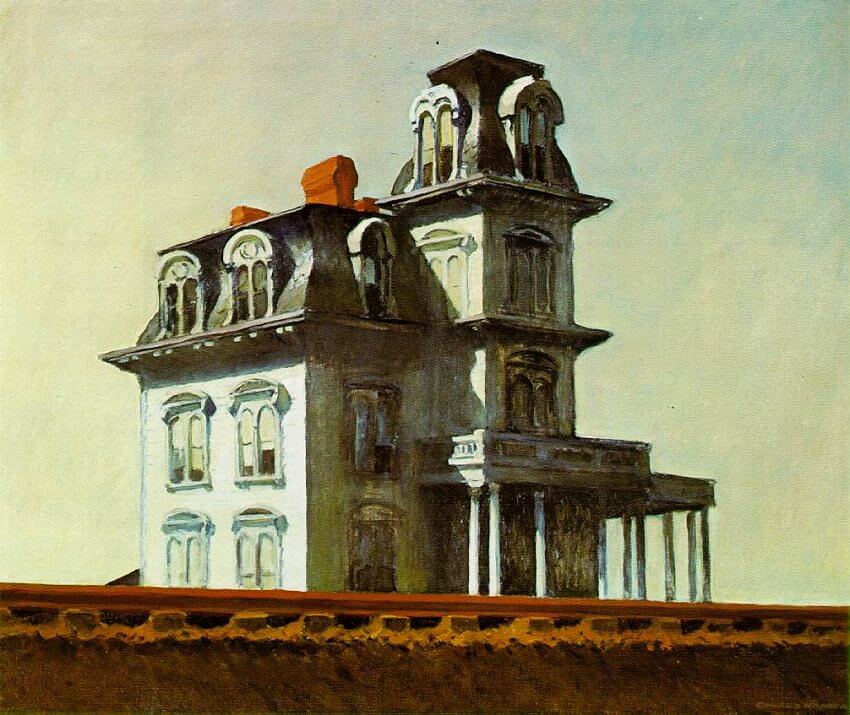
Hopper frequently used a straight. horizontal motif, usually a road or railroad track. to construct the space within the picture and to emphasize the division between the picture space and the viewer's world. Indeed, the more the viewer tries to penetrate the depths of a Hopper painting, the more impenetrable it becomes. What holds the viewer is that the artist's vision seems under control and yet, on closer inspection, the viewer realizes that the visible surface is a tissue of improbabilities and unreadable shifts in space. Hopper's view that nature and the contemporary world were incoherent contributed to his artistic vision.

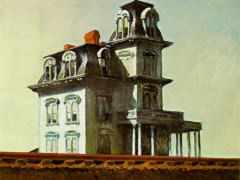
The sunlight illuminating House by the Railroad is bright enough to cast deep shadows on the stately Victorian mansion, but not to chase away an air of sadness. The painting expresses Edward Hopper’s central theme: the alienation of modern life. Instead of happy, anecdotal pictures celebrating the energy and prosperity of the Roaring Twenties, Hopper portrayed modern life with unsentimental scenes of either physical or psychological isolation. Most are set in the city, where people often look uncomfortable and out of place. Others, like House by the Railroad, picture solitary buildings in commonplace landscapes. Hopper’s House by the Railroad is symbolic of the loss that is felt when modern progress leaves an agrarian society behind.
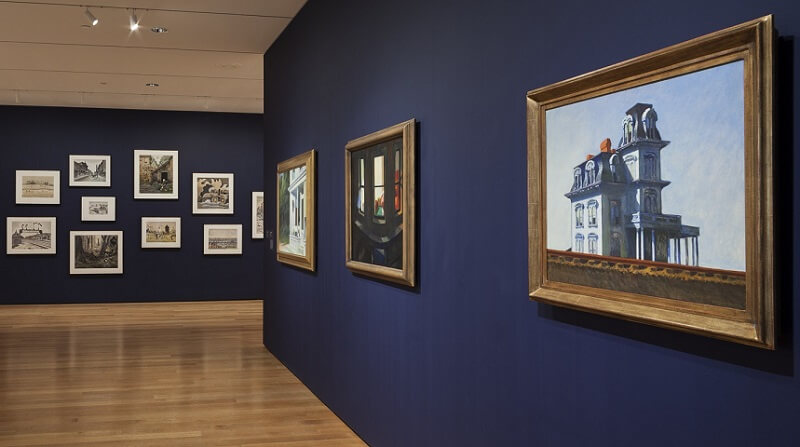
The single focus of the painting is a large gray house in an imported French style. Although Hopper customarily worked from life, he invented this house based on some he came across in New England and others he may have seen on Paris boulevards. This architectural style became fashionable in America during the mid-nineteenth century. Its hallmark is a double-pitched roof pierced with dormer windows that give height and light to the attic level. From this we might assume that the once-grand Victorian house in Hopper’s painting had been built for a large family with the means to construct a residence in the latest style. If to our eyes these antique features lend the house a certain charm, in Hopper’s time it would have appeared a clumsy relic from an awkward era — “an ugly house,” as one critic phrased it, “in an ugly place.”

Like the house, the site once may have been more attractive. The tall, hooded windows must have overlooked a landscape; the double veranda and tower were presumably positioned to take advantage of a view, probably over miles of lush countryside. Now the many windows appear tightly closed, with shades mostly drawn, as if they have become obsolete for a landscape that holds little to admire. It is possible that the house has been deserted; in any event, nature’s absence is also pronounced, similar to the industrial scene in Charles Sheeler’s American Landscape. House by the Railroad might even be considered the domestic complement to Sheeler’s work, although Hopper seems not to have felt Sheeler’s contradictory attitude toward modern life. Whether he regarded the house as lastingly beautiful or hopelessly old-fashioned, Hopper presents it as an enduring emblem of the past.

The two themes of modern progress and historical continuity come together in the second man-made feature of the painting, a railroad track running so close to the house that a passing train would have rattled its windows. From our curiously low viewpoint, the track appears to slice through the lower edge of the structure — or, to regard it in a different way, to become part of the house itself, a new foundation for American life. An enduring sign of progress, the railroad was the primary agent of industrial change. It enlarged existing cities and created new ones on the frontier. It also provided Americans with unprecedented mobility, allowing them to explore other regions of the country. But the railroad came at the cost of the American wilderness, a well-tended countryside held practical and aesthetic advantages but forever altered the unspoiled landscape that was America’s pride.

Hopper rejected European influences, maintaining that American art should capture the character of the nation. He expresses the tension between nature and culture. Although railroad tracks are typically associated with the noise, speed, and rapid change of modern life, this scene is curiously still and silent, as if the rush of industrialization has passed it by. Hopper, working in the period between the two world wars, appears to have found little to celebrate in the urbanization of America, which had destroyed its original, pastoral aspect. Here, the railroad track is the color of earth, taking the place of the stream, valley, or farmland that once formed the background of American culture.

©This artwork may be protected by copyright. It is posted on the site in accordance with fair use principles.