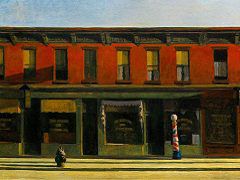
Early Sunday Morning, 1930 by Edward Hopper
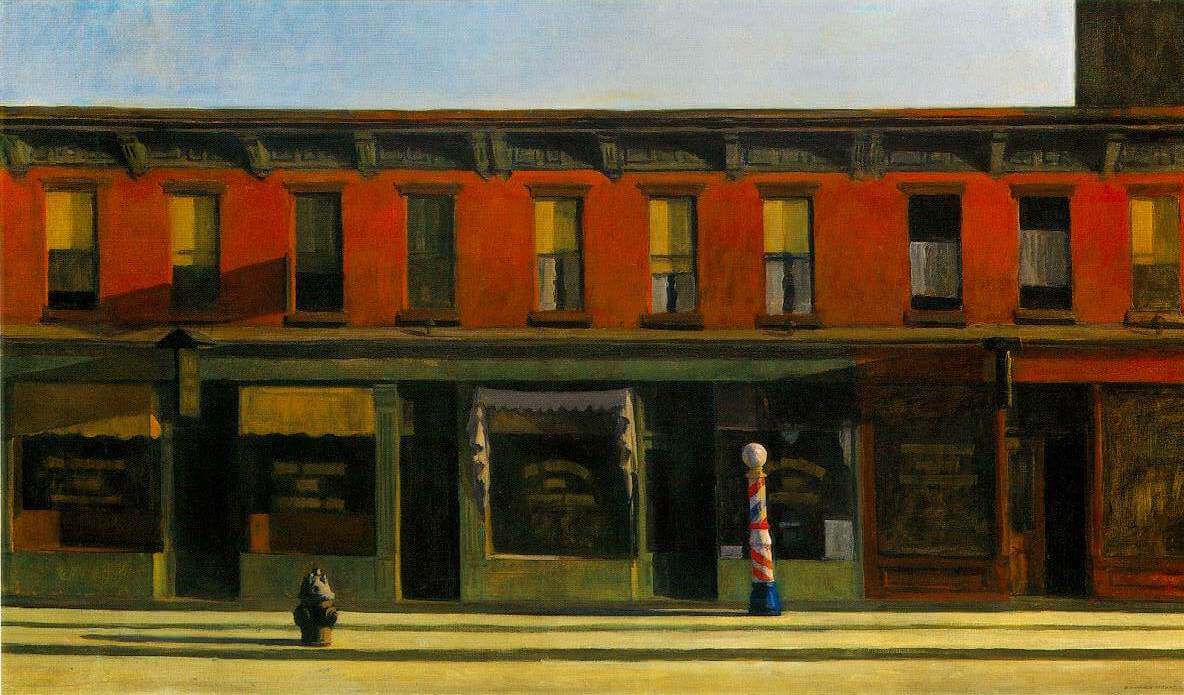
Early Sunday Morning, a painting that can either be taken as a quiet and peaceful scene of small businesses that are closed or considered a comment on the Depression. Hopper pointed out in a conversation that the word Sunday was not part of the original title. "I am fond of Early Sunday Morning, too - but it wasn't necessarily Sunday. That word was tacked on by someone else."
Although Hopper later stated that Early Sunday Morning " was almost a literal translation of Seventh Avenue", his painting appears less a specific picture of New York and more an image of America. Both the barber pole on the sidewalk and the white curtains in the second-floor apartment connote the life-styles of small-time business people throughout the United States. Originally Hoper had painted a person in the second floor window, but he later decided that the architecture conveyed his feelings and consequently painted out this individual. Although one cannot tell from the signs on the storefronts what kinds of business are represented except for the barber shop, the sizes of the buildings suggest that they provided inexpensive goods and services.
During the Depression basic industries such as steel suffered, but small, service-oriented businesses selling shoes, clothes, food, drugs, and gas stayed in business, and some even prospered: gas stations, laundries, beauty parlors, and barber shops served a growing clientele. The shops in Early Sunday Morning, which extend in a continuous line beyond the confines of the picture and reinforce the horizontal format of the canvas, emphasize the ubiquity of small-time businesses in the United States. On the upper-right corner of the picture, the dark brown passage of paint suggests the side of a large building and indicates the possible encroachment of the corporate world on this sunny block. Other shadows that are also cast from the right subtly imply that the small-time shopkeeper, the Progressives' symbol of the individual and the early nineteenth-century American ideal, is in conflict with larger, less clearly defined forces. In this manner the painting continues the Progressive ideal and obliquely refers to the shadowy realm of larger structures on the right.