Hotel Lobby, 1943 by Edward Hopper
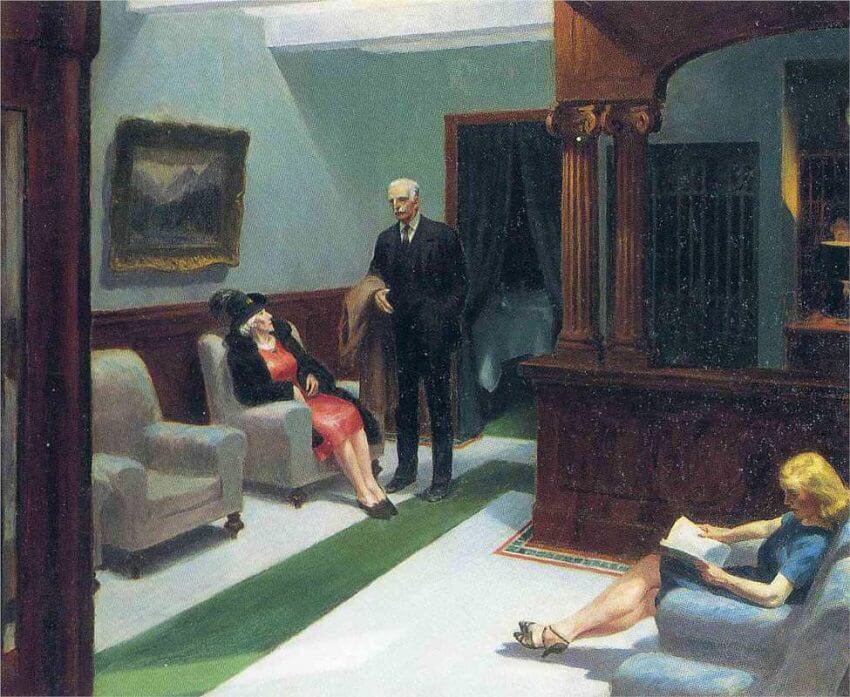
The painting depicts two women and a man in the lobby of a hotel. On the right is a woman with blond hair and a blue dress, sitting with her legs crossed and reading a book. To the left sits an older woman with a red dress, a coat and a hat. A man stands next to her, facing forward, with a suit on and an overcoat draped over his right arm. On the left wall, above the woman, is a framed landscape painting. A clerk behind the reception desk is barely visible in the shadows.
Hotel Lobby is a signature piece in Hopper's work, displaying his classic themes of alienation and brevity. The Hoppers traveled frequently, staying in many motels and hotels throughout his career. This is one of two works in his catalog that depicts a hotel, the other being Hotel Window (1955). It is also one of the two paintings that he created in 1952, both of which dealt with alienated couples. The older couple are believed to represent Hopper and his wife, themselves in their 60s. The hotel guests have been described as being "both traveling and suspended in time," reflecting a stoic and dramatic feeling, reminiscent of the film noir movies Hopper might have seen and the complex structure and feeling of works by Edgar Degas.
The painting utilizes harsh light and rigid lines to create a "carefully constructed" uncomfortable environment. The elevated and theatrical vantage point of the painting lends itself to Hopper's love for Broadway
theatre, which he often watched from the balcony.
These studies show the older couple communicating, only to cease their conversation in the final painting and reading man is replaced with a blonde young woman reading in the final painting. The modeling for both women in the painting was
done by his wife Josephine. After their marriage in 1920 she insisted on being the model for all of his female figures.
The coat the older woman wears is a fur, which is based on a fur coat owned by Hopper's wife, a coat she often wore to openings and a rare find in the Hopper's frugal household. The red (that Jo, in her journal, describes as "coral")
dress the older woman wears is believed to signify anger and extroversion, while the blue dress worn by the younger woman shows youth and distance. Throughout Hopper's sketches the clerk does not appear until the final painting. Under
X-ray it can be seen that Hopper did little to change the canvas once he began work. Most alterations were made in the position of the young woman's head and that Hopper outlined some areas in dark blue paint. A partial underdrawing was
found but little detail remains.
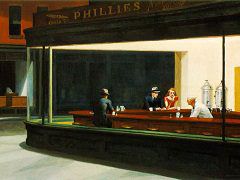
Hopper was known to model for himself for figures, as in Nighthawks, leading some to believe he may have modeled for the male figure in Hotel Lobby.
One of the few paintings by Hopper to lack windows, Hotel Lobby utilizes light from the revolving door and an unseen area from between the ceiling beams.
In 1945 Hopper was awarded the Logan Medal of the Arts and a $500 honorarium for Hotel Lobby.
ŠThis artwork may be protected by copyright. It is posted on the site in accordance with fair use principles.