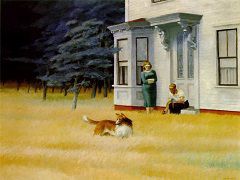
Cape Cod Evening, 1939 by Edward Hopper
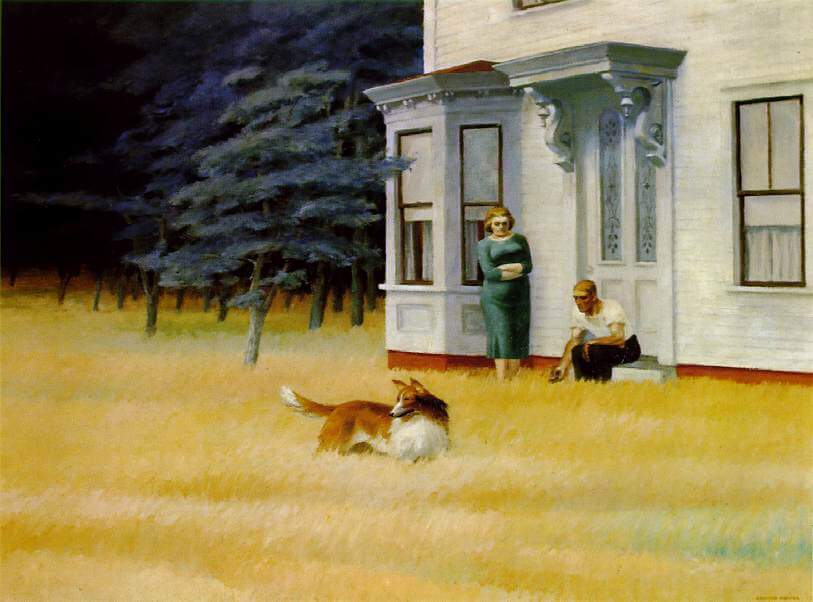
It is no exact transcription of a place, but pieced together from things in vicinity. The grove of locust trees was done from sketches nearby. The doorway of the house comes from Orleans about twenty miles from here. The figures were done almost entirely without models, and the dry, blowing grass can be seen from my studio window in the late summer or autumn. In the woman I attempted to get the broad, strong-jawed face and blond hair of a Finnish type of which there are many on the Cape. The man is a dark-haired Yankee. The dog is listening to something, probably a whippoorwill or some evening sound. ” - Edward Hopper

Cape Cod Evening is concerned with the loss of a viable rural America: it focuses on those people and places that have been left in the wake of progress. Today it is rarely remembered how enormous were the differences between the rural and urban population the late 1930s. At that time three out of every four farms were lit by kerosene lamps, a quarter of the rural homes lacked running water, and a third were without flush toilet. Cape Cod Evening was created the same year as the New York World's Fair, which was entitled The World of Tomorrow. The fair featured a robot called Elektro, which could talk and smoke, and an exhibit organized by GM entitled Futurama. Designed by Norman Bel Geddes, the GM exhibition drew twenty-eight thousand paying customers a day who sat on a conveyor belt armchair for fifteen minutes and listened to a recorded voice explaining what the American landscape would be like in 1960. To a generation that had been burdened by the Depression, Bel Geddes's predictions were less important for their accurate forecasting than for the fact that he was offering people an opportunity to begin thinking optimistically about the future.
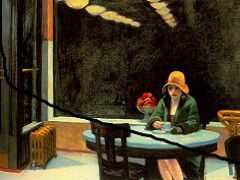
In Cape Cod Evening Hopper creates a complete contrast to The World of Tomorrow by picturing a future that is retrograde. He show how nature is reclaiming land, which less than a century before had been domesticated into the site of an imposing Victorian house with its attendant garden. Although the collie in the preliminary drawing for this painting is turned toward the couple, in the completed painting it directs its attention to the sound of the whippoorwill, which symbolizes the power of nature over culture. The Victorian house is shown standing in a field of grass; it has lost it lawn, and locust trees have advanced to the house and are in the process of taking over. The woman appears uncomfortable in the grass. Dressed in modish streamlined style, which is inappropriate for her very full figure, she is a composite of misaligned signs. Her Rubensian figure might have made her a candidate for a fertile earth mother in another era, but in the 1930s she symbolizes nature overgrown and ill at ease with itself, nature corseted and wearing bobbed hair. The onlooker of this scene is probably a local who is familiar with the lay of the land, a person who would note that the trees are locust and who thus differs from Hopper's usual observer, the motorist from a metropolitan area who regards all flora and fauna generically. The change in orientation is indicative of Hopper's own situation, for he had built a place in South Truro in 1934 and spent six months out of almost every succeeding year of the rest of his life on the Cape. His new orientation made him increasingly alert to the problems of people in the country who frequently did not have basic modern amenities and who were suffering from a sustained economic depression that extended years beyond the Great Depression.

ŠThis artwork may be protected by copyright. It is posted on the site in accordance with fair use principles.